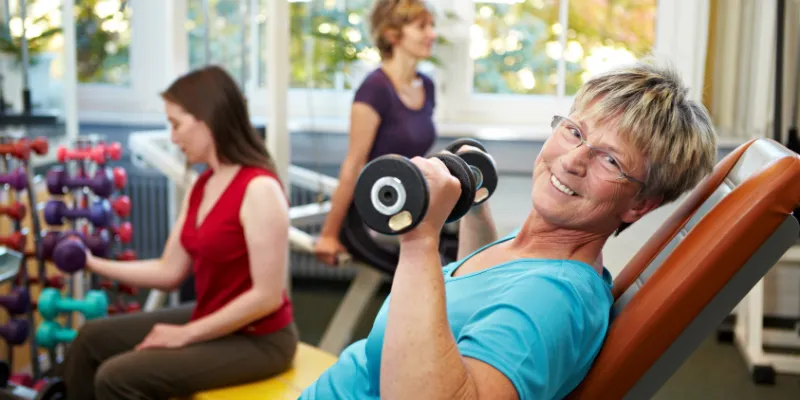
[NC4] Osteoporosis: Never too Old to Grow Stronger
At 85, Mei Hui feared she would never stand tall again. Sitting across from me with her daughter, Gloria, she described a burning, shooting pain radiating from her spine into her hips and legs - an eight or nine out of ten. She spoke softly, as if the decades-long weight of osteoporosis and a recent spinal fracture had already decided her fate. “Is there anything left besides injections?” she asked.
Path Block
Many people assume that once osteoporosis causes a vertebral fracture, the only options left are strong medications, epidural steroid injections, or fragile resignation. But research and experience show that older adults - including those in their eighties - can rebuild strength and function through properly prescribed, progressive resistance training. Clinical guidelines from Osteoporosis Canada strongly recommend that individuals with osteoporosis or vertebral fractures participate in a multicomponent exercise program that includes progressive resistance training for all major muscle groups at least twice per week. These guidelines also urge clinicians to avoid prescribing aerobic exercise alone to the exclusion of strength and balance training. That means there is no such thing as “too old” to get stronger.
Case Study
Mei Hui is an 85-year-old woman with a history of osteoporosis. She presented with disabling back and hip pain that burned and shot down her legs, with numbness below her knees. She rated her pain 8–9/10. Sitting and certain movements provided some relief. An MRI performed in early 2025 showed a subacute compression fracture at L4 and moderate-to-severe narrowing of the exiting left L4–L5 nerve roots. Under a conventional pathway, she might have been offered epidural steroid injections or facet joint injections as first-line treatments. However, our team took a different approach: we began with a functional baseline assessment.
Mini-lesson:
Multicomponent exercise programs that include muscle strengthening, balance training, and coordination are highly recommended for individuals with osteoporosis. Strengthening exercises can rebuild bones and relieve pain. Mobilization without such training may increase the risk of fracture in frail older adults.
Diagnosis Journey
After evaluating Mei Hui’s mobility, posture, and neuromotor control, we decided to postpone invasive procedures. Instead, she consulted our women’s health physical therapist. The physical therapist designed a neuromuscular training program focusing on postural muscles (spinal extensors and hip stabilizers) and functional movements like sit-to-stand and squats. Guidelines recommend that resistance training for people with osteoporosis be tailored to tolerance and include at least two sets per major muscle group, at a target of 8–12 repetitions. We started Mei Hui at a low intensity using body weight and resistance bands, gradually increasing to free weights as her confidence grew.
During the early weeks, we addressed myofascial pain by performing two trigger-point injections into her buttocks and leg muscles. These provided enough relief to allow her to focus on exercise. She practised the programme twice a week at first, with the goal of moving to three sessions per week.
She also received education on posture and safe movement, since poor posture and hyperkyphosis can impair balance and increase fracture risk; there is evidence that strengthening back muscles can improve posture and reduce pain.
Mini-lesson:
Progressive resistance training (PRT) is crucial for maintaining or improving function in older adults with sarcopenia or osteoporosis, according to the 2025 ICFSR. Combining resistance training with balance and aerobic exercise yields better outcomes than any single modality. Aerobic activity alone should not replace strength and balance training.
Turning Point
Six weeks after our first review, Mei Hui returned for follow-up. She described significant improvements: the burning pain had decreased, and she could stand up from a chair without using her arms. For the first time since her fracture, she felt strong enough to climb stairs. “I never thought I’d be able to squat at 85,” she laughed, “but now I can do it.” Her daughter noticed she was walking taller and moving with more confidence.
The key, she said, was consistency—even on days when she didn’t feel like exercising. She kept to her twice-weekly sessions, gradually adding a third. The exercises not only strengthened her muscles but also changed her perspective. Research shows that even low-intensity strength and walking programs have substantial benefits for older adults. Multicomponent physical activity—including resistance training—can delay or improve mobility disability, frailty, and loss of independence. It is never too late to attain the benefits of an active lifestyle. Mei Hui was living proof.
Resolution
By three months, Mei Hui no longer required pain medications. Her pain had diminished to a 2–3/10, and she no longer needed any spinal injections. She continued neuromotor training three times per week, adding light weights for an extra challenge. Her posture improved, her gait became steadier, and her mood lifted. She remains under regular surveillance, with periodic assessments to monitor bone health and ensure she continues to progress safely. She now encourages friends at her community center to join her exercises, proudly telling them, “There’s no age too old to get stronger.”
Mini-lesson:
Muscle-strengthening exercises can rebuild bone and relieve pain in osteoporosis. Progressive resistance training should start at least twice a week and increase as tolerated. It is never too late to benefit from an active lifestyle.
Key Learnings
Start with a functional baseline. Assess posture, balance, gait, and neuromotor control to identify gaps before prescribing interventions. Evidence shows that resistance and balance training must be tailored to individual capacity and supervised by trained physical therapists.
Strength before steroids. For older adults with vertebral fractures, consider progressive resistance training and neuromuscular rehabilitation before defaulting to epidural or facet injections. High-intensity resistance training improves bone density and functional performance, while mobilization without strength training may increase fracture risk.
Consistency and progression matter. Commit to two sessions per week at a minimum, aiming for three as the function improves. On days when you “don’t feel like it,” do something—maintain the habit. Even low-intensity programs provide benefits.
No age limit. Aerobic, muscle-strengthening, and multicomponent physical activity can delay disability and frailty, and it’s never too late to start. Older adults can see improvements in strength, mobility, and energy within months.
Takeaways for Patients & Clinicians
For Patients
Ask your provider for a functional assessment before any invasive procedures.
Embrace resistance training—even if you’ve never lifted weights before. Start with body weight or bands, then add weight as tolerated.
Make movement a habit. Two sessions per week is a starting point; aim for three when possible. On difficult days, perform at least part of your routine.
Believe that age doesn’t limit your ability to get stronger. In fact, building muscle and improving balance reduces falls and enhances independence.
For Clinicians
Evaluate mobility and posture before recommending injections or medications. Design or refer patients to supervised multicomponent exercise programs, including resistance and balance training.
Educate patients that muscle strengthening can rebuild bone and relieve pain. Encourage compliance and gradual progression; provide resources for community or home-based programs.
Recognize that progressive resistance training is crucial for maintaining function in frail older adults. Use guidelines to tailor intensity and ensure safety.
Reinforce the message: there is no age too old to start. Support older adults with encouragement, clarity, and accountability.
Brenda’s Path Forward Reflections
Mei Hui’s story challenges the ageist assumption that advanced age precludes meaningful recovery. It demonstrates that even at 85, muscles can grow stronger, bones can heal, and independence can be regained through structured, progressive exercise. As clinicians, we must move away from a reflexive reliance on injections and medications and instead integrate physical therapy and resistance training into routine care for osteoporosis and vertebral fractures. Policy makers should ensure that older adults have access to supervised exercise programs, community resources, and insurance coverage for physical therapy, because movement is medicine.
“Age is not a diagnosis. We owe it to our elders to see beyond fractures and frailty and to offer them the tools to build strength—physically, mentally, and emotionally. When we start with function and empower patients to move, we discover that healing is possible at any stage of life.” Dr. Brenda Lau


